Blog
Designing The Women-Inclusive Mosque (masjid)
In “The Ethics of Place & the Production of Space,” I made the case that a masjid must be ethically produced; it must be designed via a process that foregrounds spatial equity, and communal inclusion. Accordingly, the ethics of place is a catalyst to encourage communal consciousness to support ‘quotidian life.’ One aspect of the ethics of place relates to the knowledge that is intimately tied to Islam’s seminal masjid——the Prophet’s Masjid that was built in the city of Madina, Arabia, in the year 622 CE.
It could be argued that the seminal masjid proved acceptable as a precedent, given the weight of the Prophet’s Sunna (practice, tradition, and quotidian ethics) in general. In other words, we can develop a design paradigm based on the ‘spatial Sunna.’ Likewise, in the monograph Deconstructing the American Mosque: Space, Gender & Aesthetics, I highlighted the fact that the seminal masjid featured no partitions, no opaque screens, no architectural barriers.
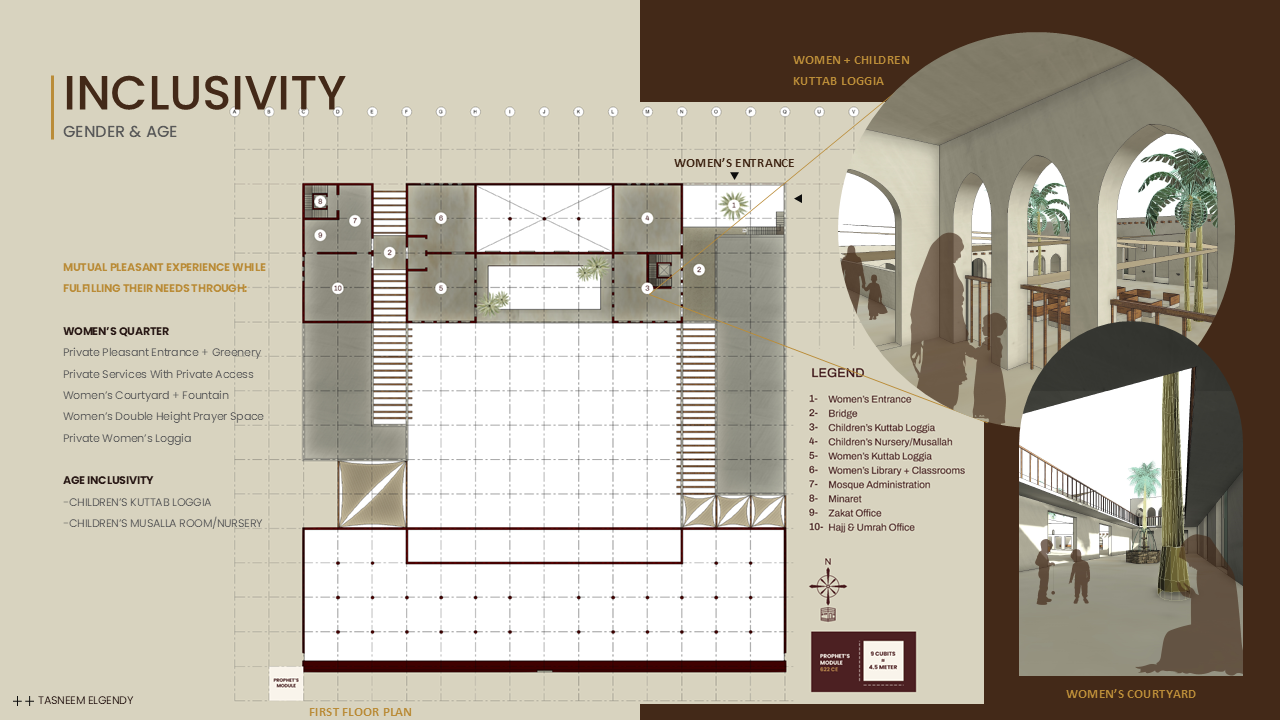
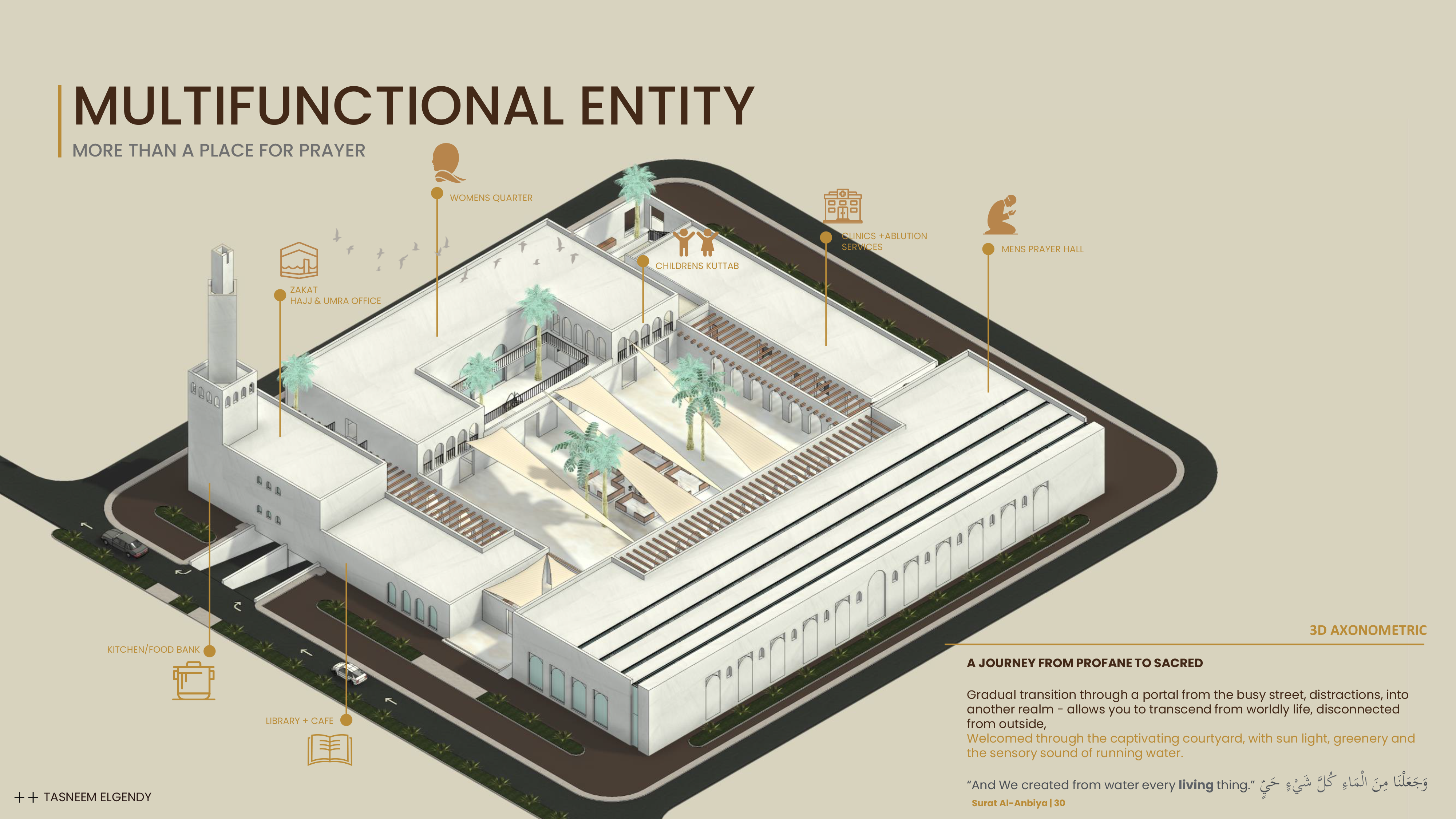
Architectural education must foreground theoretical inquiry, not as a peripheral supplement to design skills, but as a foundation through which creativity becomes socially responsible. When students examine how the power of design circulates through spatial production, they begin to design with intentionality—questioning inherited typologies, advocating for equitable access and forms of spatial inclusion. In the Spring of 2025, I tasked a cohort of seven students to design a women-inclusive masjid—they succeeded in developing a series of viable and contextually sensitive design proposals. Additionally, Tasneem Elgendy’s thesis “The Etymology of Mosque Architecture: Re-thinking Integrative Inclusive and Sustainable Design” received academic recognition for its research distinction in the College of Islamic Studies. (see the images included here)
So what exactly does a women-inclusive masjid look like? I offer here a short list of strategies that can guide the architect to design a masjid that aligns with the ‘spatial Sunna’:
- The design should include a dignified female prayer space where the visual and auditory experience is not impaired.
- The design should provide multiple entrances to eliminate the hierarchy of a “back door for women”
- The design should include ancillary spaces for lectures, scholarship and leadership that recognize women as teachers, mentors, administrators, and board members.
- The design should include child-friendly facilities that support women’s attendance.
- Most importantly the design should be developed in consultation with women as full stakeholders.
Such design strategies are not difficult for the architect or mosque planning committee to implement. We must remember that when women are welcomed and empowered, the entire community gains—families strengthen, collective devotion deepens, and children grow up seeing their mothers engaged in the practice of communal worship. Ultimately, a women-inclusive masjid honors dignity, amplifies spiritual agency, and reflects their full place in the ummah.
To achieve anything less would be to betray our faith’s most sacred values.
Akel Ismail Kahera Ph.D.