The ʿĀfiyah Index
ʿĀfiyah: Al-Mujadilah’s Index of Muslim Women’s Well-being is the first index to measure what enables Muslim women to live well and flourish across the world.
The Index combines existing quantitative approaches to measuring well-being with qualitative data missing from these frameworks. including how Muslim women live their faith, participate in family life, and belong to communities.
By centering their voices and agency, the Index aspires to an account of well-being that Muslim women recognize as genuinely their own, with the goal of informing more relevant and impactful solutions in support of their lives and aspirations.
Objectives of the Index
Integrate
Develop a framework to examine the variables shaping Muslim women’s well–being together rather than separately and capture their interactions.
Measure
Identify dimensions and indicators to analyze Muslim women’s well–being across experiences and contexts, including faith, community, belonging, and agency.
Inform
Generate evidence to support researchers, policymakers, and institutions in developing more contextually responsive solutions to help Muslim women flourish.
A new way to measure well-being
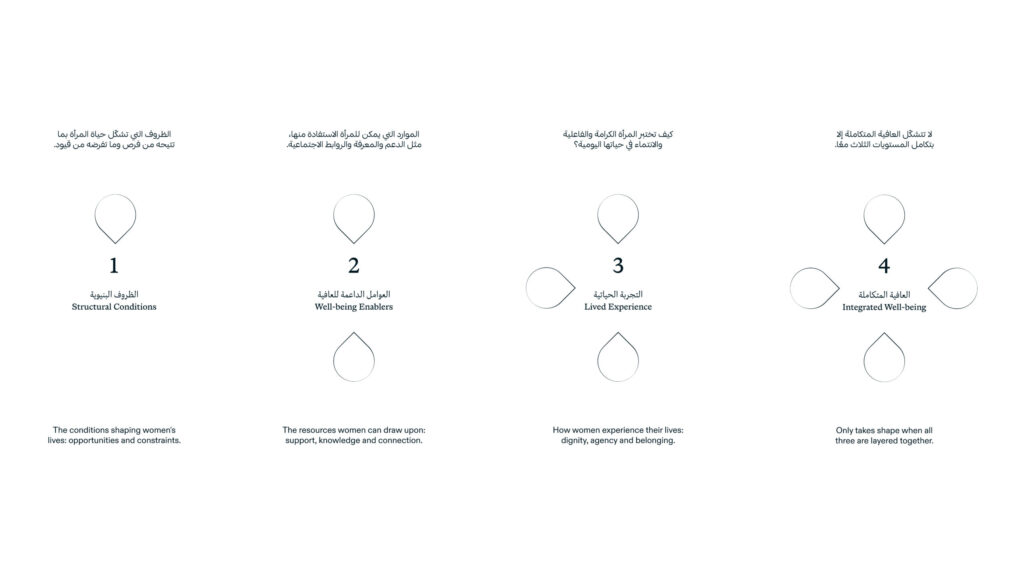
TheʿĀfiyah Index treats Muslim women’s well–being as multidimensional. This means that well–being cannot be measured by a single variable, like health or education. It is influenced by the structural conditions around a woman, the resources and relationships available to her, and how those variables interact with each other to produce an integrated experience of well–being.
While health and education are part of these variables, they also include faith, family life, labor-force participation, decision-making, civic engagement, safety, and belonging.
What makes it different
Multi-faceted
Considers social variables often overlooked or examined separately, such as religious knowledge, community, and belonging.
Context-sensitive
Recognizes the diversity of Muslim women’s experiences across Muslim majority countries and post-conflict areas.
Agency-centered
Captures how Muslim women’s choices and actions shape their wellbeing, beyond the conditions that influence their lives.
Faith-inclusive
Recognizes the role of faith and spirituality in well–being, including access to religious knowledge and authority.
Capacity-enhancing
Engages diverse institutions to identify and build on existing resources and structures that support Muslim women’s advancement.
Policy-oriented
Translates research findings into practical insights that help decision makers develop policies and initiatives responsive to lived experiences.
A phased approach:
Phase 1: Developing the Framework
Reviewing how well–being is currently measured and understood, and developing a new methodology that reflects Muslim women’s diverse experiences.
Phase 2: Gathering Institutional Insights
Working with relevant partners, including religious institutions, to collect and analyze data that will inform the development of the first draft of the Index.
Phase 3: Conducting Surveys and Validating
Gathering individual perspectives through surveys across participating countries and working with research and statistical partners to test and validate the Index.
Get Involved:
As the initiative enters its first phase, institutional collaboration will play an important role in shaping a research framework that reflects the diverse experiences and contexts of Muslim women. Join us in building a stronger foundation of knowledge to support Muslim women’s well-being and flourishing.